
Choosing the right pipe in water supply projects, agriculture, fluid transfer and implementation of facility networks has a direct impact on the implementation cost and long-term performance of the system. If the pipe diameter is not selected correctly or its working pressure does not match the project conditions, additional costs may be incurred for replacement, repair and rerouting. For this reason, the technical specifications of the product and the real needs of the project should be checked before purchasing.
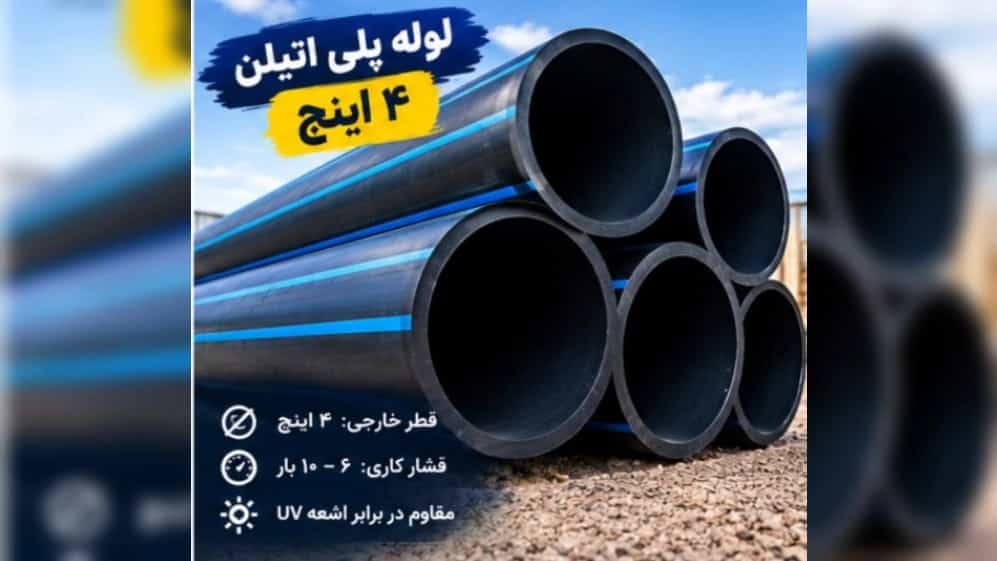
4 inch polyethylene pipe is one of the widely used sizes in water transmission lines and some industrial and agricultural networks. This product is usually known with a nominal outer diameter of 110 mm, and depending on the raw material, wall thickness and pressure range, it can be used for various conditions. Of course, the final selection is not based on size alone; Required flow rate, network pressure, path length and type of fluid are also important.
In this guide, you will get to know the specifications, applications, selection method, price determining factors and important points of buying 4 inch polyethylene pipe so that you can make a decision according to the needs of the project.
What are the characteristics of 4 inch polyethylene pipe?
In the market, the title of 4-inch polyethylene pipe is usually used for a pipe with a nominal outer diameter of 110 mm. However, when ordering, the nominal diameter should be separated from the internal diameter. The outside diameter alone does not determine how much fluid will pass through the pipe; Because the thickness of the wall is also effective in the inner diameter.
The most important technical specifications of this pipe are:
- Nominal outer diameter: usually 110 mm.
- Materials: Depending on the product and application, different grades of polyethylene such as PE80 or PE100 are used.
- Wall thickness: It changes according to the dimensional category and required working pressure.
- Nominal pressure category: must be according to the design The network and technical specifications of the product should be selected. Production standard: It must be compatible with the type of application and project requirements. Connection type: According to the network design, methods and connections compatible with the pipe can be used.
So, if you are going to buy a 4 inch polyethylene pipe, don't settle for just the name of the size. It is better to include the nominal diameter, material grade, thickness, pressure category and production standard in the pre-invoice or technical specifications of the order.
In what cases is the 4-inch polyethylene pipe used?
One of the reasons for the acceptance of this size is the possibility of using it in routes that require more water passing capacity than small diameter pipes. Of course, the appropriateness of the size should be checked with hydraulic calculations and the actual conditions of the project.
1. Water transmission and distribution lines
In some water supply projects, 4-inch polyethylene pipe is used to transport water in the main or secondary routes. The choice of this size depends on the amount of water required, the length of the path, the allowable pressure drop and the inlet pressure. In long networks, checking pressure drop and flow rate is especially important.
2. Agricultural irrigation systems
In farms and gardens where water must be transported from the source or pumping station to several sections, this pipe can be part of the transmission or distribution line. Before choosing, pump flow rate, height difference, number of branches and required pressure at consumption points should be determined.
3. Green space projects
In some irrigation networks of green spaces, parks and large areas, the use of 4-inch polyethylene pipe can be investigated to transfer water to the secondary lines. The final size must be in harmony with the irrigation plan and network capacity.
4. Industrial and institutional applications
In some industrial applications, polyethylene pipe is used to transport fluids compatible with the pipe material. In this situation, it is necessary to check the type of fluid, temperature, pressure, chemical compatibility and safety requirements. Every polyethylene pipe is not necessarily suitable for transporting any type of fluid.
How to choose the working pressure of 4 inch polyethylene pipe?
One of the most important criteria when buying is the pressure category of the pipe. Two pipes with the same outer diameter may have different pressure tolerance due to the difference in wall thickness and raw materials. For this reason, it is not possible to determine the working pressure only from the expression "4 inches".
Check these factors to make the right choice:
- Typical network pressure: The pressure with which the system works under normal conditions.
- Instantaneous pressure increase: For example, ram shock caused by turning the pump on and off or rapid closing of valves.
- Grade of raw material: Type of material and technical specifications declared by the manufacturer.
- Thickness and dimensional ratio: SDR ratio It is obtained by dividing the nominal outer diameter by the nominal thickness; At a fixed diameter, a lower SDR usually means a thicker wall.
- Operating temperature and installation conditions: Temperature, pipe restraint and environmental conditions can affect the final choice.
For example, the nominal pressure listed on the product should be interpreted with the standard and its reference conditions and should not be considered equivalent to the allowable pressure in all working conditions without checking. In sensitive projects, make the selection based on the plan, calculations and approval of the technical officer.
What is the difference between 4 inch polyethylene pipe and similar sizes?
Sometimes the buyer hesitates between different sizes and thinks that choosing a bigger tube is always better. While increasing the diameter may increase the cost of purchase and connections, and choosing a smaller diameter can also increase the pressure drop. The appropriate size should be determined based on the actual needs of the network.
Smaller pipes may be suitable for branch lines or lower flows; While the 4-inch polyethylene pipe is checked in the routes that need more passage capacity. Larger sizes may also be required for higher flow transmission lines.
Don't just compare diameter to make a decision. Put the following specifications together:
2. The length of the route and the height difference;
3. Inlet pressure and permissible pressure drop;
4. Number of branches and type of connections;
5. The cost of preparation, installation and maintenance.
If the diameter of 110 mm is specified in the project plan, check the same specification with the seller when purchasing so that there is no mistake between the nominal size and the expected actual size.
The price of 4 inch polyethylene pipe depends on what factors?
The price of 4 inch polyethylene pipe is not fixed and may change according to product specifications, market conditions and order quantity. To compare sellers' offers, it is better to check the prices of products with the same technical specifications.
The most important factors influencing the price are:
Quality and grade of raw materials
The type of raw materials and production quality affect the performance and price of the product. For water supply projects or pressurized applications, check product specifications and traceability, and don't just base your decision on low price.
Wall thickness and pressure range
With the outer diameter being fixed, increasing the wall thickness usually increases the amount of materials used and can affect the price. On the other hand, the pressure category should be selected according to the project's needs; Purchasing a product with inappropriate specifications may create unnecessary expense or reduce network security.
Order length and quantity
The number of branches, the total area and the method of packaging can be effective in the final cost. In project or bulk orders, it is better to inquire the price for the exact amount needed and include the shipping cost in the calculations.
Shipping cost and delivery location
Large size pipes need a suitable carrying space. Therefore, the discharge location, distance to the project and loading conditions can change the finished cost. When receiving the price, specify whether the stated amount includes shipping or is only for the product itself.
Connections and installation requirements
The cost of running the network is not limited to the pipe. Fittings, valves, conversion parts, installation tools and implementation costs should also be included in the project estimate.
To get the price according to your needs, prepare the technical specifications and the size and ask Zamzam Pipe website. For direct communication, you can also call 09120596640.
What points should we check when buying a 4 inch polyethylene pipe?
In order for the purchase to match the needs of the project, check a few important items before placing the order.
First, specify the technical specifications. Instead of just saying "4 inch pipe", specify the nominal diameter of 110 mm, the material grade, the pressure category and the intended application.
Secondly, check the documents and the standard of the product. The type of standard should match the application of the pipe. If needed, request a technical data sheet and manufacturer information.
Third, compare the price with products of the same specifications. The lower price is a good criterion when the quality, thickness, pressure class and delivery conditions are also comparable.
Fourth, consider the connections from the beginning. Dimensional compatibility of pipes and connections, connection method and space required for installation should be checked before purchase.
Fifth, clarify the delivery conditions. Specify the order amount, unloading location, delivery time and shipping cost before finalizing the order.
Following these points, the probability of purchasing mistakes will be reduced and the planning of project costs will be done more accurately.
Installation and maintenance of 4 inch polyethylene pipe
Even a high-quality pipe can have problems if installed improperly. Before implementation, check the piping route and prepare the substrate according to the technical instructions. The presence of sharp stones, sharp objects or improper support can damage the pipe body.
At the time of moving, avoid pulling the tube on rough surfaces and giving strong impact. Also, the permissible bend radius, connection method and restraint method must be observed according to product specifications and executive instructions.
After installation, testing and commissioning of the network should be done in a proper way and according to the requirements of the project. The test pressure should not be guesswork; Because it must be compatible with the specifications of pipes, fittings, valves and test instructions.
For buried lines, burial depth, soil type, bed density and surface loads are also important. In the paths where cars or machines pass over the pipe, the design and mechanical protection must be done according to the project conditions.
Why should we contact Zamzam Pipe for purchasing inquiries?
Choosing the right pipe becomes easier when the required specifications of the project are properly matched with the product to be delivered. Before ordering a 4-inch polyethylene pipe, it is better to have information such as size, type of application, required working pressure, delivery location and the need for connections ready.
To view information and order tracking, visit Zamzam Pipe official website. You can also call 09120596640 to inquire about the price and coordinate the purchase.
If you are not sure which size or pressure category to choose, explain the project specifications when you call so that it is possible to check the options that suit your needs. Before finalizing the purchase, clearly confirm the technical specifications and delivery conditions.
summary
4 inch polyethylene pipe, commonly known with a nominal outer diameter of 110 mm, can be used in water transmission lines, some agricultural networks, green spaces and industrial applications compatible with polyethylene. However, the right choice is not only limited to the diameter and factors such as material grade, wall thickness, pressure category, fluid type and installation conditions should be considered.
For an economical and safe purchase, compare the prices of similar products, consider the cost of shipping and connections, and confirm the technical specifications before placing an order. To inquire about 4 inch polyethylene pipe and get more information, visit zamzampipe.ir or call 09120596640.
Frequently asked questions about 4 inch polyethylene pipe
1. How many millimeters is a 4-inch polyethylene pipe?
This size in the market is usually considered equivalent to the nominal outer diameter of 110 mm. However, the inner diameter depends on the wall thickness; So, check the technical specifications of the product for exact order.
2. How is the price of 4 inch polyethylene pipe calculated?
The price depends on factors such as raw material grade, thickness, pressure category, order size, shipping conditions and production specifications. In order to receive a comparable price, state the technical specifications and required quantity when making an inquiry.
3. Is 4 inch polyethylene pipe suitable for agricultural irrigation?
This pipe can be used in some agricultural water transmission or distribution lines; But its suitability depends on flow rate, path length, working pressure, height difference and network design. It is better to check the hydraulic requirements of the project and the pressure category of the pipe before buying.
To inquire about the price and buy 4 inch polyethylene pipe, visit Zamzam Pipe or call 09120596640 call.