
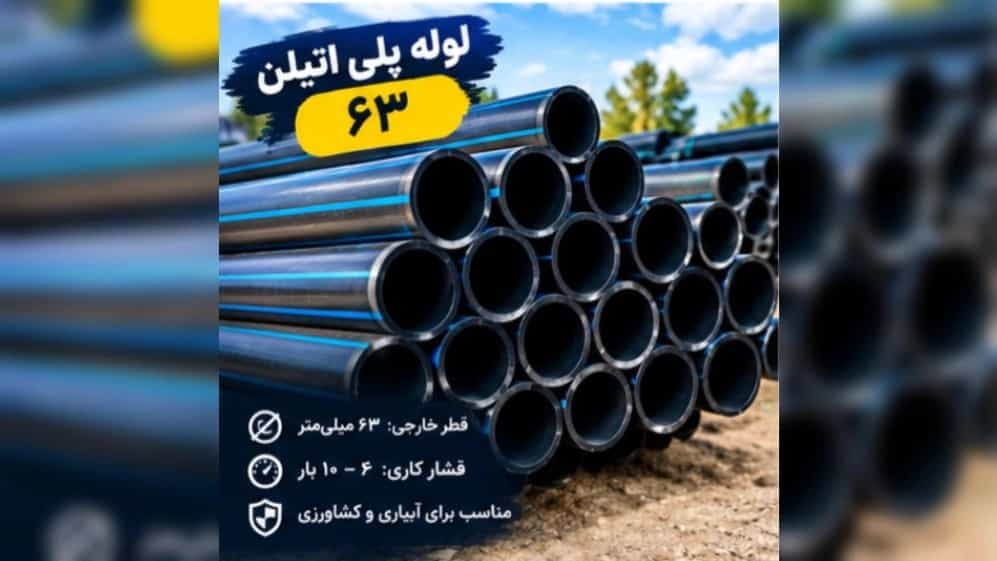
If you are looking for a pipe with the right diameter for an irrigation system, water transfer or running a water supply network, it is very important to check the technical specifications before buying. Selecting a product based solely on price or nominal size may increase running costs, pressure drop, or connection incompatibility. For this reason, knowing the outer diameter, wall thickness, working pressure and type of raw materials is an important part of the purchase process.
63 mm polyethylene pipe is one of the most widely used sizes in some agricultural and water supply networks, which can be used to transport water in different ways according to the production specifications. In the market, this product is usually known as 2-inch polyethylene pipe; However, the nominal outer diameter and exact specifications of the product should be checked when ordering.
In this article, we examine the characteristics of polyethylene pipe 63, its applications, the difference in working pressures, the factors affecting the price and the important points of purchase. We also explain how to avoid unnecessary costs by choosing the right specifications.
To view products and get more information, visit Zamzam Pipe website or call 09120596640.
What is polyethylene pipe 63 and what is its use?
One of the important points is that the number 63 shows the nominal outer diameter of the pipe; Not its inner diameter. The inner diameter depends on the wall thickness. Therefore, two products with the same outer diameter may have different water passing capacity.
The common uses of this size are:
- Water transfer in parts of water supply networks
- Using in the main or secondary lines of some irrigation systems
- Water transfer in gardens and agricultural lands
- Water supply for some facilities and compatible industrial applications
- Use in networks that require this diameter based on technical calculations
The most important technical specifications of polyethylene pipe 63
When buying polyethylene pipe 63, it is necessary to check several characteristics side by side. This information will help you choose a product that is compatible with the working conditions of the network.
Outer diameter and inner diameter
The nominal outer diameter of this product is 63 mm. This size is important for choosing many connections; But the inner diameter changes according to the thickness of the wall.
For example, a pipe with a thicker wall, for the same external diameter, has less internal space for water to pass through. Therefore, if the goal is to transfer a specific flow rate, the internal diameter and pressure drop of the path should also be checked.
wall thickness
The thickness of the wall is one of the main factors in the weight and pressure of the pipe. As the thickness increases, the amount of material used per meter usually increases. This issue can affect the weight and price of the product.
Appropriate thickness should be determined based on working pressure, product standard and design conditions; Not just based on buyer preference or lower price.
Grade of raw materials
Polyethylene pipes may be produced with different grades of raw materials, including PE80 and PE100. These grades have different mechanical characteristics and their selection depends on the standard and design of the product.
For a safe purchase, request information about the raw materials and technical documents of the product from the seller and adapt them to the needs of the project.
nominal pressure
Nominal pressure indicates the pressure range defined for the product under certain standard conditions. 63 polyethylene pipe may be supplied with different thicknesses and working pressures; Therefore, the size name alone is not enough to determine the tolerable pressure.
In pressurized projects, normal system pressure, pressure fluctuations, fluid temperature and installation conditions should be considered in the final selection.
Is polyethylene pipe 63 suitable for agricultural irrigation?
One of the important applications of 63 mm polyethylene pipe is the use in parts of agricultural irrigation systems. This size can be suitable for transporting water in specific routes and feeding sub-lines; Of course, the final choice depends on the network design.
For example, in an agricultural land, a 63 mm pipe may be suitable for a part of the water transmission path, but in another project, a different diameter is needed due to the long path or higher flow rate.
Before choosing an agricultural pipe, check these factors:
- Land area and type of crop
- Amount of water required per hour
- Length of water transfer path
- Number of branches and outlets
- Inlet pressure and height difference
- Type of irrigation system, such as drip or rain
If this information is known from the beginning, the pipe size and required working pressure can be chosen more accurately. This prevents buying inappropriate products and incurring additional costs.
To check options for purchasing polyethylene pipes, visit Zamzam Pipe website and call 09120596640 to inquire about the order conditions.
What is the difference between 63 and 2 inch polyethylene pipe?
In the market, 63 mm polyethylene pipe is commonly known as 2 inch pipe. This naming is common, but at the time of purchase, you should pay attention to the nominal outer diameter included in the technical specifications.
Mathematically, the conversion of inches to millimeters has a specific size; However, pipe sizing is not always done solely on the basis of direct conversion of units. Dimensional standards and common market nomenclature also play a role in size determination.
To avoid mistakes when ordering:
If the pipe is to be connected to an existing line, the exact matching of the external diameter and the type of connection is more important; Because the difference in dimensions can make the installation process difficult.
How is the price of polyethylene pipe 63 determined?
The price of 63 mm polyethylene pipe depends on the product specifications and market conditions. For this reason, in order to receive an accurate price, the type of pipe, wall thickness, nominal pressure and order amount must be known.
Pipe thickness and weight
Pipes with different thicknesses, even in the same external diameter, do not have the same weight. Increasing the thickness usually increases the amount of raw materials used per meter and can change the price.
For this reason, when comparing two quotes, you should make sure that the thickness and pressure category of the products are the same.
Raw materials and production quality
The grade of raw materials and the quality of the production process affect the mechanical properties of the product. A pipe produced for a specific application must meet the technical requirements related to the same application.
A lower price alone does not indicate a more economical purchase; Because a mismatched product may increase the cost of repair, replacement or stoppage of the project.
Working pressure and SDR
The dimensional ratio of SDR is obtained by dividing the nominal outer diameter by the wall thickness. At a given outside diameter, a lower SDR number usually means a thicker wall.
Since the wall thickness is related to the nominal pressure, the difference in SDR can affect the weight and price of the pipe. However, the final allowable pressure should be determined according to the grade of raw materials and the standard of the product.
Order amount and shipping cost
Purchase amount, delivery location, loading cost and shipping method also affect the final cost of supply. In bulk orders, it is better to specify the additional costs in the pre-invoice in addition to the price per meter.
To receive the updated price of polyethylene pipe 63, prepare the necessary specifications and size of your order and follow up through Zamzam Pipe website or number 09120596640.
How to choose the right working pressure of polyethylene pipe 63?
Choosing the right working pressure is one of the most important buying steps. If the nominal pressure of the pipe does not correspond to the actual conditions of the system, the operation of the network may face problems.
To choose the right pressure, first determine the normal operating pressure. Then possible increases in pressure, ram impact, fluid temperature and installation conditions should be checked.
In the market, polyethylene pipes are offered with different pressure categories; But not all grades are necessarily available for every diameter or application. Therefore, before placing an order, check the actual specifications of the product.
For example, in an irrigation network with low working pressure, a product with a different pressure category than a high-pressure transmission line may be required. The final decision should be made based on the engineering design and approved specifications of the pipe.
It is also necessary that connections, valves and other components of the network are compatible with the working pressure of the system. Choosing the right pipe, regardless of the quality of the connections, will not guarantee the correct operation of the entire network.
What factors does the weight of polyethylene pipe 63 depend on?
The weight of each meter of polyethylene pipe 63 depends on the thickness of the wall, the density of the raw materials and the production characteristics. For this reason, it is not possible to declare a fixed weight for this size without knowing the thickness and grade of raw materials.
The weight of the pipe is especially important in bulk purchases; Because it affects the cost of transportation, loading capacity, and how to move.
To calculate the total weight of the order, first the weight of each meter is obtained from the valid specifications of the product. Then this number is multiplied by the size of the order. If the weight of the product is not declared in the catalog, it is better to ask the seller for detailed information.
In large orders, it is also important to coordinate the length of the branches or coils, the way of packing and the possibility of unloading at the project site.
Guide to buying polyethylene pipe 63 from Zamzam Pipe
To make the right purchase, first specify the project's needs and then ask the supplier about the technical specifications and order conditions. This method allows the price offer to be adjusted based on your real needs.
At the time of inquiry, state the following:
- Required nominal outer diameter: 63 mm
- Desired working pressure or pressure range
- Pipe use in the project
- Order amount in meters or number of branches
- Need for connections and accessories
- Destination city and shipping conditions
After receiving the offer, check the technical specifications, price, delivery time and shipping cost. If the product is used for a sensitive project, confirm the required technical documents and standards before purchasing.
Zamzam Pipe has enabled online communication with customers through the website zamzampipe.ir. To get more information about polyethylene pipe 63 and order conditions, you can call 09120596640.
Prepare the specifications and size you need right now and contact Zamzam Pipe to inquire about the price and terms of supply.
Correct maintenance and installation of polyethylene pipe 63
Maintaining pipe quality is not only limited to the purchase stage. Transportation, maintenance and basic installation also play a role in the final performance of the network.
For proper maintenance, place the tubes on a flat surface and avoid contact with sharp objects or surfaces that can cause damage. During loading and unloading, avoid heavy impact or pulling the pipe on the rough surface.
At the time of installation, it is important to prepare the substrate, comply with the permissible bend radius, correctly execute the connections and perform the necessary tests. The manufacturer's instructions should be the basis for maintenance and installation.
If the network is under pressure, the necessary tests must be performed according to the project design and technical criteria before operation. In large or sensitive projects, the execution of operations under the supervision of an expert can reduce the possibility of errors.
purchase of polyethylene pipe 63; From inquiry to placing an order
Choosing the right product becomes easier when the technical specifications, order quantity and delivery conditions are clear from the beginning. Checking these items will help you compare different offers more accurately and avoid unexpected expenses.
If you need 63 polyethylene pipe for agricultural irrigation, water transfer or utility projects, first specify the diameter, working pressure and quantity of your order. Then, by checking the product information and sales conditions, choose the option that suits the needs of the project.
To view product information, visit Zamzam Pipe official website.
For direct communication and inquiries about purchase conditions, call 09120596640. When calling, state the required details so that a more detailed review of the order is possible.
Frequently asked questions about polyethylene pipe 63
1. How many inches is the polyethylene pipe 63?
Polyethylene pipe with nominal outer diameter of 63 mm is usually known as 2 inch pipe in the market. However, when purchasing, you should check the outer diameter listed in the technical specifications; Because the inner diameter is dependent on the thickness of the wall, and the outer diameter is important for the selection of connections.
2. What is the price of 63 mm polyethylene pipe?
The price of this product depends on the wall thickness, nominal pressure, raw material grade, production quality, order quantity and shipping cost. Check products with the same specifications to compare prices. To inquire about the daily price and order conditions, call 09120596640 or visit Zamzam Pipe site.
3. Is polyethylene pipe 63 suitable for agricultural irrigation?
This size is used in some agricultural irrigation systems; But its choice depends on water flow rate, path length, working pressure, number of branches and network design. To ensure the right choice, match the system specifications with the pressure and inner diameter of the pipe and if needed, get help from a technical expert.